

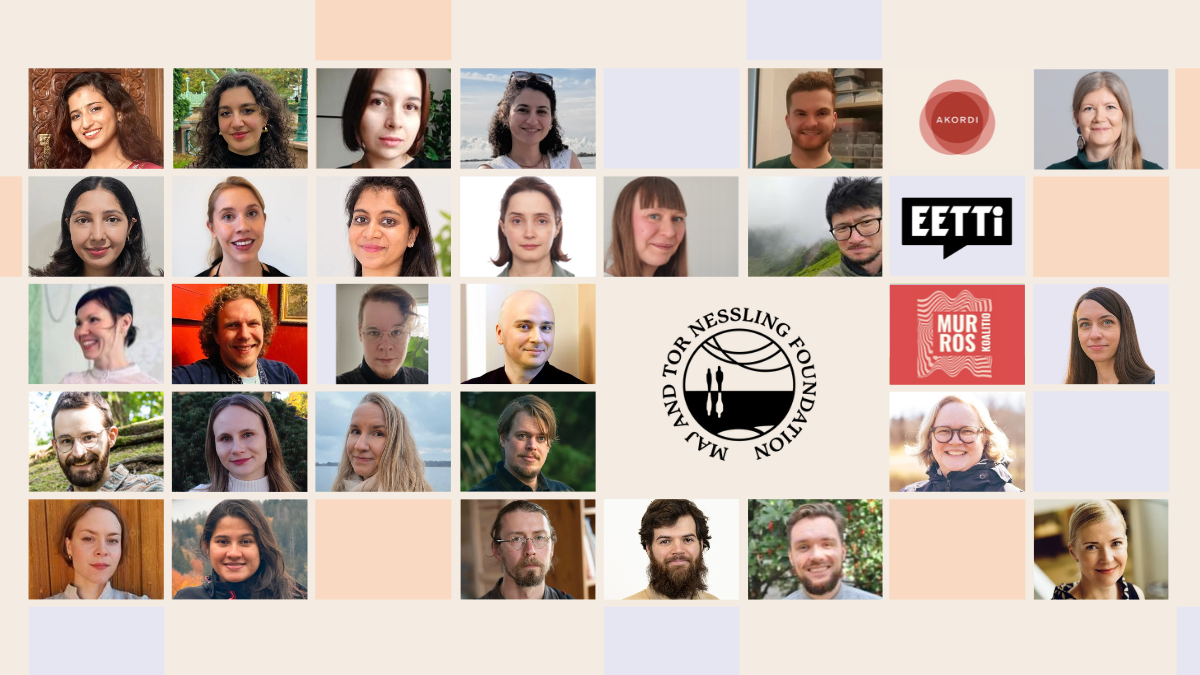
The Nessling Foundation’s general grant call has funded 32 projects that seek to bring human activity back within planetary boundaries. A total of 14 doctoral researchers, 11 postdoctoral researchers and seven science-based action projects will advance sustainability transformation from a wide range of perspectives.
This autumn, the Nessling Foundation’s general grant call sought active researchers and actors whose projects speed up the sustainability transformation that protects natural systems.
Sustainability transformation requires far-reaching change across all areas of human life. This breadth was particularly evident in the applications submitted to this year’s call.
Research projects explore solutions for sustainability transformation across disciplines
Most of the projects funded in this grant call were research projects. Funding was awarded to 14 doctoral researchers and 11 postdoctoral researchers, each seeking solutions to the ecological crisis from their own unique perspective.
Iina Koskinen, Science and Executive Director of the Nessling Foundation, was impressed by the range of research projects selected for funding:
“The range of funded projects is remarkably broad. Among them are particularly interesting projects in engineering and the natural sciences that could lead to significant solutions for reducing environmental pressures. We are also funding research that addresses deeper societal leverage points for sustainability transformation: beliefs, values and worldviews, as well as the socio-ecological systems that maintain the status quo,” Koskinen says.
The researchers selected for funding were also able to demonstrate in their applications how communication and interaction can strengthen the societal impact of their research.
Examples of funded doctoral research projects:
- Ece Acundatek (University of Helsinki) studies human–animal conflicts, focusing on barnacle geese living in Helsinki’s urban areas. The research seeks to understand how tensions between members of different species arise and develop. Its findings can help explore opportunities for coexistence between humans and wildlife.
- Janni Saari-Kontkanen (University of Eastern Finland) examines the regulation of microplastic emissions through environmental law research, exploring how regulation can help reduce microplastics at different stages of their life cycle.
- Petri Lahtinen (University of Helsinki) studies the concept of psyche in Greek natural philosophy. Psyche can be understood as a useful conceptual tool for viewing nature as a complex, interdependent whole. Lahtinen explores how the concept could be applied in contemporary ecological thinking.
Examples of funded postdoctoral research projects:
- Katariina Lahti-Leikas (HAMK Häme University of Applied Sciences) studies the effects of pesticides on soil and how using different pesticide mixtures affects processes such as their degradation and binding in soil. The project will generate knowledge to reduce the environmental pressures caused by pesticides and support more realistic assessments of their risks.
- Elias Willberg (University of Helsinki) studies people’s accessibility needs from the perspective of necessity, sufficiency, and overconsumption. The goal is to understand whether lower levels of accessibility can sometimes be better from a planning perspective. The project helps to target accessibility improvements in areas that need them most, while considering social inequalities and environmental impacts.
- Tapio Reinekoski’s (Tampere University) research is about circumventing climate action and decarbonisation in urban governance, insurance and carbon offsetting. The project analyses urban climate governance and the insurance of carbon offsetting and seeks to understand the political and economic rationales with which both fields look for controllable, equitable and profitable climate risks.
The most common host institutions for the research projects were the University of Helsinki (eight projects) and the University of Turku (seven projects).
Explore all funded research projects here
Action projects to develop new ways of working
Alongside research projects, the Nessling Foundation supports science-based action projects. In this grant call seven action projects received funding, and are ready to put research on sustainability transformation into practice.
The projects address topics including aquatic environments, forestry and regenerative agriculture. Several of the selected action projects also develop new ways of working, build collaboration and strengthen society’s capacity for change.
Examples of funded science-based action projects:
- Pro Ethical Trade Finland – Eetti ry strengthens young people’s ability to imagine sustainable futures through role-playing. The project will develop a short educational role-playing game set in a post-overconsumption world. Through the game, young people will explore overconsumption as a societal, environmental and global justice issue, while practising how to imagine alternative futures.
- Ekososiaalisen murroksen tuki ry will establish a coalition for ecosocial transformation, bringing together actors working to advance sustainability transformation and developing a shared, long-term plan for achieving change. The pilot project will organise two conferences to lay the foundations for sustained collaboration.
- Baltic Sea Action Group’s Muutosvoima project responds to the urgent need to initiate a systemic sustainability transformation in forestry. The project places forest owners at the centre as active participants in the transformation. Its goal is forestry that operates within planetary boundaries.
Explore all funded action projects here
All funded projects:
- Doctoral researchers: Shreeja Achar, Ece Acundatek, Alisa Belmas, Aashu Bhattara, Karoliina Elfving, Vinidu Gelani Gamage, Amanda Halme, Petri Lahtinen, Kaarle Mäkelä, Siméon Rapin, Sonja Rapo, Janni Saari-Kontkanen, Suvi Salminen, Nishadi Wimalajeewa
- Postdoc researchers: Lobna Amin, Chris Chisholm, Akhgar Kaboli, Katariina Lahti-Leikas, Che Liu, Tapio Reinekoski, Markus Sjöberg, Pasi Takkinen, Oliver Tomassi, Mari Vanharanta, Elias Willberg
- Science-based action projects (& project lead): Akordi oy (Jonna Kangasoja), Baltic Sea Action Group (Taina Ihaksi). Pro Ethical Trade Finland – Eetti ry (Leena Honkasalo), Ekososiaalisen murroksen tuki ry (Alisa Rannikko), Natural Resources Institute Finland (Sini Valmari), University of Tampere (Essi Aarnio-Linnanvuori), Water Protection Association of the River Vantaa and Helsinki Region (Anu Oksanen)
A record number of applications
The Nessling Foundation’s general grant call once again attracted a record number of applications. A total of 843 applications were submitted, an increase of approximately 44 per cent from last year’s 586.
“We received an enormous number of excellent project proposals, which meant that many outstanding researchers and actors could not be funded this time. I hope, however, that an unsuccessful application will not discourage anyone. Given the current state of the world, we need research, new ideas and action that accelerates sustainability transformation more than ever,” says Iina Koskinen.
- Applications received: 843
- Projects funded: 32
- Total funding awarded: €3,209,769
- Success rate: 4%