
The environmental impacts of animal production are indisputable, but the Finnish food system is locked into traditional structures and dividing lines. The multidisciplinary research team of the ResPro project is building realistic future scenarios for the food system and identifying points where different perspectives can meet. The aim is for small steps to pave the way for a broader transformation of the system. The ResPro project received funding from the Nessling Foundation’s Murros-call.
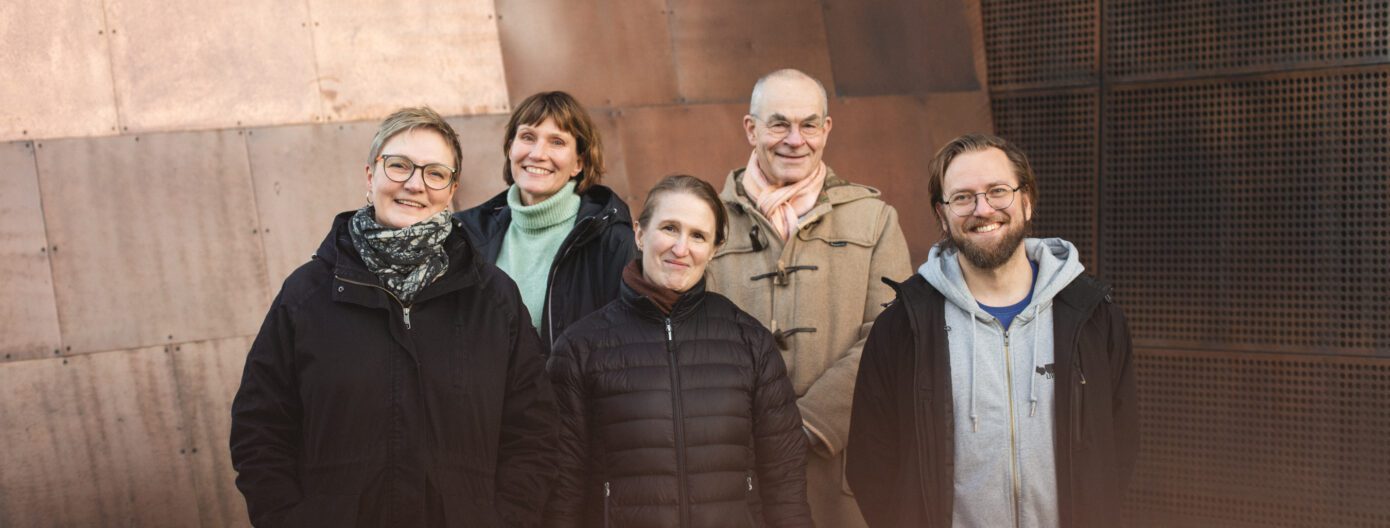
In the picture, from left: Reetta Mietola, Heli Nordgren, Nina Janasik, Janne Hukkinen, Tuure Tammi
Photography: Annukka Pakarinen
The divide between meat and plant proteins or more precisely, between their proponents is clearly visible in Finnish public debate. This dividing line, and the fact that both sides cling firmly to their own views, is currently preventing the Finnish food system from changing in a more sustainable direction.
“Our current meat-centred food system has been in place for quite some time, since the Second World War. The current system is, so to speak, one pole of the polarisation, and at the other pole is the system’s challenger. At the moment, the views of these parties are clashing with one another, and we are unable to move forward from this deadlock,” says Nina Janasik, the leader of the ResPro project.
The project addresses a difficult issue and aims to act as a bridge-builder between the different parties. It is looking for a pathway of change that everyone could, in one way or another, accept.
“Current livestock production has many environmental impacts. We know that, in the long term, the system needs to change. We want to identify the next possible and feasible steps of change that challenge existing systems. At the heart of our work is a shared dialogue in which all parties are heard.”
By the environmental impacts of livestock production, Janasik is referring, for example, to the fact that animal production, including animal feed, accounts for 12–20 per cent of global greenhouse gas emissions. The entire food chain, in turn, is estimated in studies to be responsible for around 26 per cent of all human-caused greenhouse gas emissions. Other significant environmental impacts of food production include, for example, eutrophication and soil acidification.
In the ResPro project, a multidisciplinary team is exploring scenarios for different futures of protein production. Veterinarians from the Faculty of Veterinary Medicine at the University of Helsinki are involved from a biosecurity perspective and bring in their expertise on what animal health and welfare currently mean in Finnish animal production. Additionally, the project includes social and environmental policy researchers from the University of Helsinki, representing a range of perspectives, as well as educational researchers from the University of Oulu who focus on viewing animal production through the lens of multispecies relations. In practice, they approach the theme, for example, from the lifeworld of cattle – how does the cow or another animal experience the world and how do different actors take this into account? Researchers at the University of Helsinki also focus on how justice between different groups of people is realised in the necessary transition. For instance, how the change will affect agricultural producers.
The project leader, Nina Janasik, is an environmental social science researcher whose previous areas of interest have included, for example, pandemic risks related to animal production and climate change preparedness in Finnish cities. In the project, one of her tasks is also to reconcile the differing perspectives within the team.
“Our group’s internal views are, in principle, quite different to begin with and represent different research discussions. But we are looking for those points where we can find the same wavelength. For almost two years now, we have been building mutual understanding, and we now have quite a clear idea of how this can work. In the group, everyone is very open to the fact that we have different perspectives. It takes skill to handle these differences.”
The internal diversity of perspectives within the consortium is an asset for achieving the project’s objectives. In practice, the research project will generate a range of scenarios as to what the next steps towards more sustainable animal protein production might be. Developing a shared vision requires both a method that enables different views to be heard and the skill to identify points of convergence between different perspectives. In this project, the Industrial Foresight Studio (IFS) method developed by the BIOS Research Group is used for this purpose. Janasik considers the involvement of food producers to be particularly important.
“We cannot move beyond the current deadlocked situation unless there is a vision of what the next step would be from the producers’ point of view.”
In the project, there is discussion of alternative or possible protein futures. How does Janasik see these futures taking shape?
“I don’t want to speculate too much, as our work is only just beginning and I want to trust the results it will produce. However, on the basis of previous research, we do know that answers could be found, for example, through biosecurity or technology. Some might criticise our method by saying that it only allows us to move forward by a small step. Perhaps, but we believe that through the small we can get to the big. So for us, this is about how we can connect the next possible step with the broader change that is needed.”
ResPro is one of the two projects funded in 2025 through the Nessling Foundation’s Murros-call. The Murros-call sought projects that that generate deeper understanding, new perspectives, and science-based solutions for breaking away from structural overconsumption. By the deadline, 41 applications were submitted, of which two received funding. Learn more about the other Murros project here.
Project name: From a False Sense of Protein Safety to Protein Resilience: Building Bridges for Protein Sustainability (ResPro)
Project implementers: The project is led by the University of Helsinki. Co-implementers are the University of Oulu (Faculty of Education and Psychology) and the BIOS Research Unit.
Duration: 2 years
Funding amount: 500 000 €
Description: The current polarization between opponents of animal production and industry stakeholders has reached a deadlock where both sides remain firmly entrenched in their own perspectives. This dynamic does not serve the goals of sustainable development – nor the objectives of either group. What we need are bridge-builders: initiatives that can facilitate dialogue and seek common ground.
The project “From a False Sense of Protein Safety to Protein Resilience: Building Bridges for Protein Sustainability (ResPro)” seeks alternative yet realistic compromises that enhance both environmental and animal welfare, while also addressing the overconsumption of animal-based products. ResPro does this by challenging the hegemony of the current production system centered around industrial price with a new vision centered around biosecurity and animal health. ResPro conducts in-depth empirical research on the currently insufficiently articulated risks in Finnish animal protein production, explicitly juxtaposing the economic paradigm of productivism with other very different ontologies and epistemologies, such as multispecies justice. ResPro applies the method of the Industrial Foresight Studio (IFS), a collaborative platform for science-based planning of next generation industrial and innovation policy among corporate actors, government officials, policymakers, researchers, and relevant stakeholders. Protein resilience forms one of the cases for which the new IFS tool is innovatively applied.