
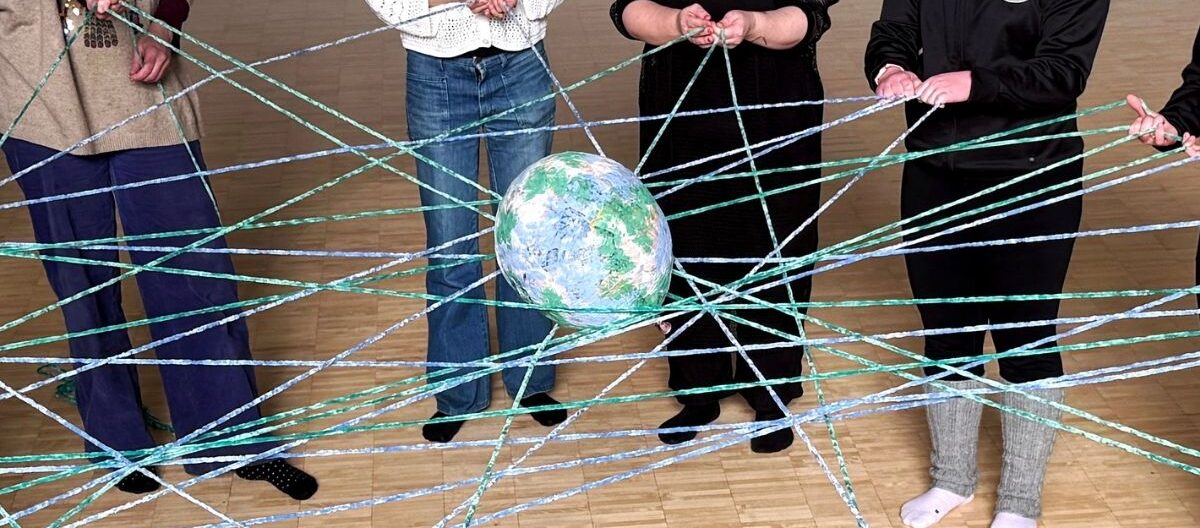
The Planetbic and Planetary Workshops project, carried out in collaboration with JYU.Wisdom, aims to transform participants’ relationship with the world into a more sustainable one through shared thinking, creative action and dialogue. In this blog post, Sonja Salomäki, who leads the science-based action project funded by the Nessling Foundation, describes how the creativity emerging from the workshops has taken the project in unexpected directions.
Text: Sonja Salomäki
Sustainability transformation is not only an intellectual or societal process – it is also a creative and embodied one. In the Planetbic and Planetary Workshops project, transformation advances through experimentation and learning in unique situations created within temporary workshop communities.
The fact that seven of the nine planetary boundaries have already been transgressed is both a dramatic and daunting starting point for our work. One of the project’s central aims has therefore been to explore how planetary boundaries are connected to everyday life in Finland and to identify the opportunities each of us has to act.
During the project’s first year, six workshops were organised in which participants designed and carried out creative actions for the planet. The underlying assumption is that scientific knowledge provides a powerful source of motivation and inspires people to take action.
Research shows that people’s sense of agency can be strengthened through collaboration and by witnessing the agency of others. Everyone who has participated in the Planetbic project is therefore a potential change agent. The new ideas and perspectives generated through the project may encourage participants to move towards lifestyles that respect the Earth’s limits and ignite a spark for sustainability transformation that continues to spread long after the workshops have ended.
The project has engaged a diverse group of participants through various communities and institutions in Jyväskylä. Their knowledge, experiences and backgrounds vary considerably. Participants have included young adults, future teachers, Finnish-born and international residents, as well as researchers and students from JYU.Wisdom, whose expertise has ensured that the scientific content on planetary boundaries remains accurate and relevant.
The project’s unusual name originates from the artistic component of my practice-based doctoral research: Planetbic, an “Earth workout” that combines group exercise, demonstration, spoken word poetry about planetary boundaries, and a deliberately low threshold for participation.
The project’s science-inspired creative work has the potential to stimulate new ways of thinking and strengthen trust between people. It engages the body, emotions and dimensions that go beyond rational thinking. Together, these elements can shake the psychological defence mechanisms that help us cope with the reality of the Earth’s declining carrying capacity.
The creative work carried out in the workshops has resembled community art, dialogical art and, at times, even art therapy. Rather than striving for spectacular artistic outcomes, the emphasis has been on creating, experimenting and discussing from many different lived experiences. After maturing in participants’ minds, these experiences may later contribute to transformative change across different areas of society and everyday life.
Discussions have sometimes reached profound questions concerning values and the meaning of life. At other times, participants have worked together in complete silence. Casual chatter has also been entirely welcome.
Artistic expression in the project has included rap music, craftivism, drawing, collage poetry, painting, movement, video, dance, teaching simulations and cooking together.
Creative actions for the planet
The workshop series began with a pilot session involving members of JYU.Wisdom. Together, they refined the workshop concept and designed a collective creative intervention for the planet. After many iterations, the result was a trilogy of videos with subtitles styled after classic Finnish films. In these nostalgic scenes, romanticised figures reminiscent of traditional Finnish imagery wander through contemporary national landscapes: clear-cut forests, tree plantations and drained peatlands. Along the way, the videos offer a critique of economically driven environmental and forest policies, as well as the contradictions embedded in Finland’s nature-based national brand.
The first public workshop took place at the Girls’ House (Tyttöjen Talo). While artistic activities were already familiar to participants, connecting art with planetary boundaries was something new. The workshop reinforced the understanding that responsibility for the planet’s future cannot rest solely on young people. Participants, who had only recently reached adulthood, were highly critical of those in positions of power and saw “older male politicians” as primarily responsible for the current state of the world.
Participants from JYU.Integra, all of whom had higher education backgrounds, understood approximately 80 per cent of the spoken Finnish. Despite the complexity of the topic, they engaged deeply with the concept of planetary boundaries, although such a demanding subject is naturally easier to grasp in one’s native language. Hearing about planetary boundaries directly from another person, rather than encountering the information on a mobile phone screen, makes the issue feel immediate and impossible to simply scroll past.
Some of the most memorable moments of the workshop were the quiet periods of intense concentration during the creative exercises. More generally, working with one’s hands appeared to help participants organise their thoughts while also supporting conversation. During the workshop it became increasingly clear that, in the planetary workshops, the process itself matters far more than the final artistic outcome.
The workshop organised together with the Faculty of Sport and Health Sciences reached student teachers completing a minor subject in education, many of whom might otherwise never have reflected on their role as agents of sustainability transformation. Apparently, planetary wellbeing is covered in only a single course during their studies, despite teachers having enormous potential to drive societal change.
The sports science students were creative, enthusiastic and willing to throw themselves into the exercises. An important insight from the workshop was that advancing sustainability transformation often requires stepping outside established norms and experimenting with new ways of acting. That takes courage, but it can also be deeply rewarding.
Participants at the Finnish Craft Museum already had a strong understanding of the ecological crisis and many had experience in activism, enabling particularly profound discussions. They valued creating together, the peer support that emerged through shared activities, and the idea of gentle advocacy through craft. Alongside the scientific overview of the state of the planet presented by the workshop’s scientific advisor, Emma, participants identified humanity itself, political decision-makers, contemporary capitalism, and the relentless pursuit of economic growth, profit and financial gain as the world’s greatest problems.
The workshop at Gloria Multicultural Centre focused on food – perhaps one of the most meaningful and rewarding ways to approach planetary boundaries. Food and food production are both highly tangible and among the most powerful drivers of change. The workshop formed part of the FEE Global Action Days campaign under the theme of climate and food.
As an artist, I naturally found myself asking what food can become as an artistic medium. Plants, cultivation, food and eating are inseparable from aesthetics and the senses. Food evokes emotions and brings people together. Sharing a meal transcends language barriers and even disagreements – eating together can itself become dialogue and a form of dialogical art.
The final workshop was held in an intimate recording studio in Vaajakoski with three young rap artists alongside professional musicians Ossi Soul Valpio and Joni-Veli. Working with semi-professional and professional artists within a single artistic medium created a focused and purposeful atmosphere, despite the immense scale of the topic that was intended to inspire the creative work. Unusually, the scientific advisor for this workshop was Panu Halme, who has previously collaborated with Valpio on science-art projects. The young artists’ thoughtful lyrics spoke of Mother Earth, nature, and humanity’s capacity both to harm and to heal.
Workshops with real impact
At the beginning and end of each workshop, participants completed a short impact survey. Although the results should be interpreted as indicative – not everyone responded, and some participants changed between the first and final surveys – the responses nevertheless provide valuable insights into how the core elements of the workshops, including the scientific overview of the state of the planet, the introduction to activist art, and the creative assignments, succeeded in stimulating participants’ thinking.
Overall, the survey suggests that creative work helped participants better understand climate change and biodiversity loss. The workshops also increased participants’ general sense of creativity. While lasting behavioural changes are difficult to measure, participants appeared to leave the workshops feeling slightly more empowered as potential agents of change than when they arrived.
Open-ended responses revealed that participants overwhelmingly viewed humanity as responsible for today’s environmental crises. At the same time, they generally perceived their own influence as limited. Interestingly, only a few reflected on questions of power, justice or the role of political decision-makers in slowing sustainability transformation.
Most workshop participants were women. This may have been entirely coincidental, or it may raise an interesting question: is defending the planet somehow perceived as a soft, caring and therefore feminine activity? Is sustainability transformation something that the stereotypically rational homo economicus would not naturally embrace? Art and creativity may well have reinforced the perception that the workshops had a feminine character. Yet this does not change the fact that sustainability transformation requires far more than measurement and optimisation. It also demands creativity, imagination and the ability to think differently – qualities needed across all genders.
Although the workshops were local, closed events and the impact assessment remained relatively small in scale, I would argue that the project nevertheless succeeded in extending sustainability transformation beyond the usual circles and into a wide variety of social and professional communities.
What comes next?
The project’s entire body of work is currently on display at the Old School temporary art exhibition in the former upper secondary school building in Jyväskylä until 30 August 2026. Planetbic’s videos, photographs and textile works form part of a large collaborative exhibition created by around 700 artists and contributors.
Throughout the summer we will also be publishing humorous planetary-themed content on our social media channels – follow along!
It would feel almost absurd to conclude the project without already thinking about what comes next. I intend to seek follow-up funding and continue developing the concept further. The Planetbic and Planetary Workshops model has clearly proven its value, which is why it deserves to continue. Perhaps future collaborations will even involve companies or professional artists.
Borrowing the central message of one of Planetbic’s key inspirations, Arnold Schwarzenegger’s Pump for Planet initiative:
Start small. Make it a habit. Keep going.
- Allocate sufficient resources for production, communications and specialist support – one person cannot do everything.
- Bring communications interns on board if you want to create more content while also developing your skills in organising work, supervising others and giving clear creative briefs.
- Schedule time for reading, learning, thinking and resting.
- If you decide to run a project in another city, do so consciously and with careful planning – it comes with both advantages and disadvantages.
- Keep track of your working hours and avoid taking on too much.
- Make sure you have days when you simply allow yourself to be human.
- Don’t try to realise every idea within a single project, no matter how many brilliant ideas emerge.