
Established norms in the construction sector ensure safety in construction, but do they at the same time hinder change? A new two-year research project examines how these structures sustain overconsumption and what would need to happen for the sector to genuinely move onto a more sustainable path. In this project, a particular focus is on concrete because of its significant emissions. The BLINK project received funding from the Nessling Foundation’s Murros-call.
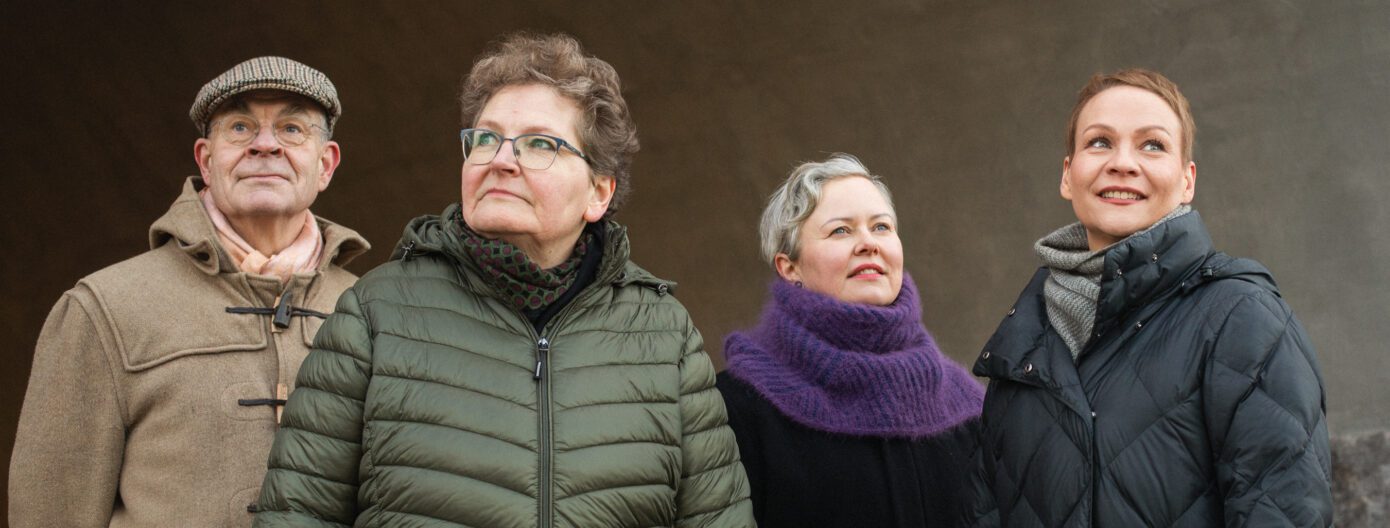
In the picture, from left: Janne Hukkinen, Pirjo Kuula, Katja Soini, Katja Tähtinen
Photography: Annukka Pakarinen
No house or railway line would ever be completed without the construction sector’s established norms and processes. Projects are large, construction must be safe, and every actor in the chain needs to know their role. The flipside is the rigidity of these processes.
”Our hypothesis is that the construction sector’s norms and long-established practices are preventing the sector from addressing overconsumption. We want to shake up these processes – are they really necessary in their current form, and how might they be used to transform the sector so that it becomes sustainable?” says Katja Tähtinen from the Building Information Foundation. She leads the BLINK research project, which also includes the University of Tampere, AFRY and the BIOS Research Unit.
What does overconsumption in the construction sector actually look like?
Globally, buildings and construction account for around half of all the natural resources we consume and around 40 per cent of primary energy. The building sector is also responsible worldwide for about 35 per cent of greenhouse gas emissions and 30 per cent of waste.
From individual building materials, concrete is responsible for the largest share of emissions from the construction sector. It has been said that if concrete was a country, its carbon dioxide emissions would be the third largest in the world, after the United States and China. For this reason, concrete has been chosen as a particular lens through which the project approaches the issue.
”If we could find more effective solutions for reusing concrete, that alone would bring about a major change. At the same time, concrete is the building material that provides a particularly useful window onto the sector’s structures and the industries connected to it.”
Tähtinen notes that, typically, the construction sector tends to focus on technical solutions to make the industry more sustainable. The project she leads, however, aims to bring about systemic change.
”The root causes of overconsumption do not lie with individual experts, organisations or technologies, but really in the very structure of our society. How is construction regulated, what kinds of contracts are made, and how do these affect the planning of construction and, in turn, the grassroots level? It is also a question of what we value: we should be proud of our existing building stock, care for it and use it more.”
Through the project, Tähtinen and her colleagues are therefore seeking to influence the entire value chain and network of actors in the construction sector. In practice, alongside scientific research, the project will include, for example, a pilot project testing new practices that tackle overconsumption. It also involves policy advocacy and brings together different actors along the construction value chain to develop solutions together. The prospects for impact are promising as the implementing organisations give the project reach across nearly the entire Finnish construction sector.
Tähtinen herself is Research Director at the Building Information Foundation and a part-time Professor of Practice at Aalto University. Other researchers from the Building Information Foundation are also involved in the project, and the foundation also brings its broad networks across the sector.
The management consulting company AFRY provides the project its experts, concrete construction projects, and networks to disseminate the project’s results. There are also researchers from the research centre Terra from University of Tampere who examine infrastructure construction processes and the case-study. The Industrial Foresight Studio (IFS) of the BIOS Research Unit serves within the project as a forum for communication, interaction and implementation, and as an empirical research platform together with stakeholders.
Although the project is well positioned for driving change, the path towards that change is unlikely to be easy. Construction is a business sector like any other, so how does Tähtinen think companies will be willing to tackle overconsumption?
”Overconsumption is not a problem only in construction – it is something that needs to be addressed across society as a whole. For example, our economic models should be reoriented towards circular economy. But for companies today, it is also very much the case that sustainability values and living up to them are intrinsically important so that the planet remains liveable for future generations and is not damaged unintentionally by business activities. Inevitably, the construction sector like any other will have to confront this, because the pressure is so great.”
Blink is one of the two projects funded in 2025 through the Nessling Foundation’s Murros-call. The Murros-call sought projects that that generate deeper understanding, new perspectives, and science-based solutions for breaking away from structural overconsumption. By the deadline, 40 applications were submitted, of which two received funding. Learn more about the other Murros project here.
Project name: Systemic Overconsumption in the Construction Value Chain: Root Causes and Transformation Opportunities, with Concrete as a Lens
Project implementers: The project is led by the Building Information Foundation. Co-implementers are the University of Tampere, AFRY Finland Oy and the BIOS Research Unit.
Duration: 2 years
Funding amount: 500 000 €
Description: The project examines structural overconsumption in construction, arising from entrenched norms, guidelines, decision-making structures, and incentives. Concrete is used as a lens to show how structures and value chains hinder resource efficiency and how they can be redirected toward ecological, economic, and technical sustainability. The multidisciplinary approach combines scientific analyses with practical expertise in construction and infrastructure. The research builds on theories of sustainability transitions, institutional change, regulatory systems, and the circular economy. It includes literature reviews, case studies, and BIOS workshops where stakeholders assess drivers of concrete overconsumption and future trajectories. The material includes literature reviews results, documents, contracts, interviews, and surveys. Key outputs: a systemic map of barriers and opportunities; a tested model project illustrating decision-making points, indicators, contractual and design solutions that promote resource efficiency and circularity; policy recommendations; communication materials, impact events, and a knowledge base for guidelines. Impact will be achieved by embedding results into guidelines, practices, and by piloting them in client projects. Through established networks and activities, the consortium reaches a wide range of industry actors, ensuring the results inform decision-making, shape practices and drive long-term change in the sector.