
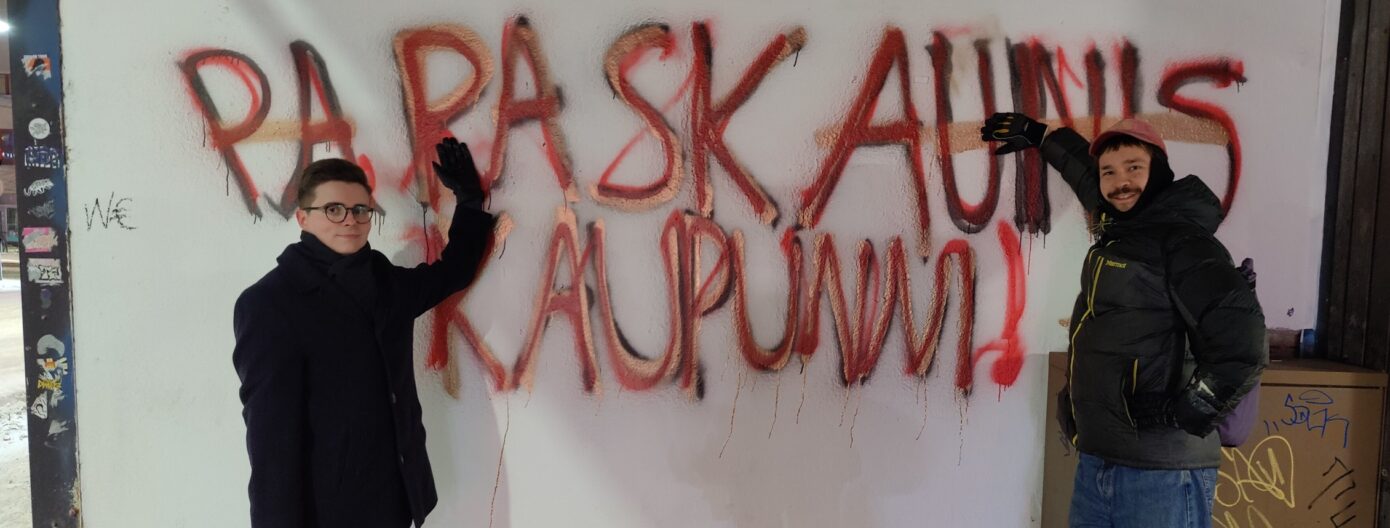
A sustainability researcher’s reality is shaped by dramatic political currents and the active pushback of multiple opposing forces. At the same time, societal threats can also open up opportunities for researchers to make their voices heard. Over the past three years, Otto Snellman has seized these opportunities while working on a doctoral thesis project funded by the Nessling Foundation.
You can next hear about Otto’s research on 5 February at Puistokatu 4, in a public discussion on the tactics used to obstruct climate action. The event can be followed via livestream on Puistokatu 4’s YouTube channel. Please note, that it will be held in Finnish.https://energyandcleanair.org/publication/when-coal-wont-step-aside-the-challenge-of-scaling-clean-energy-in-china/
Text: Otto Snellman
Three years is both a blink of an eye and a small eternity in an era of eco-social crises. I began my doctoral thesis project on hypocrisy in the politics and ethics of ecological crises roughly three years ago. In that time, the world has not changed radically—quite the opposite—but the intensification of forces opposing the sustainability transformation has slowed the flow of time.
Finland’s political leadership would rather sacrifice climate and biodiversity commitments than moderate logging levels. The United States no longer bothers to conceal its fossil and raw-material imperialism. Despite a recent plateauing of emissions, coal remains a stubborn component of China’s energy system and industry, while the country’s petrochemical sector is booming. Israel, which has emerged in the 2020s as a regionally significant exporter of fossil gas, continues its illegal occupation of Palestine and the genocide in Gaza.
It’s a sign of troubling times when the obstruction of the sustainability transformation is sold as “realism” and “pragmatism”.
Survival strategies
Within the university, it remains alarmingly easy to lose touch with the present moment and become absorbed in competition, career strategising, and other demands of academic capitalism.
For me, the most effective counterforces have been:
- university democracy, in the form of demanding an academic boycott of Israel together with colleagues and students
- concrete action in the forest protection movement, especially mapping the nature values of threatened forests
- collective efforts to understand the present moment
An example of the latter is my essay from September 2023 on “dialogue washing” by Finnish forestry companies. The essay was prompted by shared, concrete experiences and observations within the environmental movement. In the essay I sought to develop a concept that could capture people’s frustration and criticism of the “conversational” content marketing and public-relations practices that the companies engage in.
I wanted to inject the concept of dialogue washing quickly into the conversation and see whether people would find it useful. That is why I wrote an easily approachable essay rather than a scientific article. The interest the concept generated was surprisingly strong. The essay led to many engaging and sometimes unexpected discussions, even though the academic publication is still forthcoming.
Another attempt to grasp the present moment is our upcoming public discussion on the development of climate obstruction: Have We Already Given Up? New Forms of Climate Obstruction. The event at Puistokatu 4 is fully booked, but the livestream can be followed on 5 February from 3 to 5 pm here. The event will be held in Finnish.
I am organising the event together with doctoral researcher Sakari Säynäjoki and ILMEST project researchers Sonja Pietiläinen and Tero Toivanen. Joining us in discussion are Ville Lähde from the BIOS Research Unit, as well as environmental activist and municipal councillor Elina Kauppila.
Partners in crime
For my doctoral process, finding the right “partners in crime” across disciplinary boundaries has been crucial. While many names could be mentioned, the most important by far has been Sakari Säynäjoki.
Sakari is my colleague in practical philosophy. In many other fields, collaboration is the norm rather than the exception, but theoretical and conceptual research in philosophy is often relatively solitary, perhaps especially at the doctoral stage. Working with Sakari has been my first experience of genuinely doing research together. It has refined my thinking more than any lone writing or reading exercise ever could.
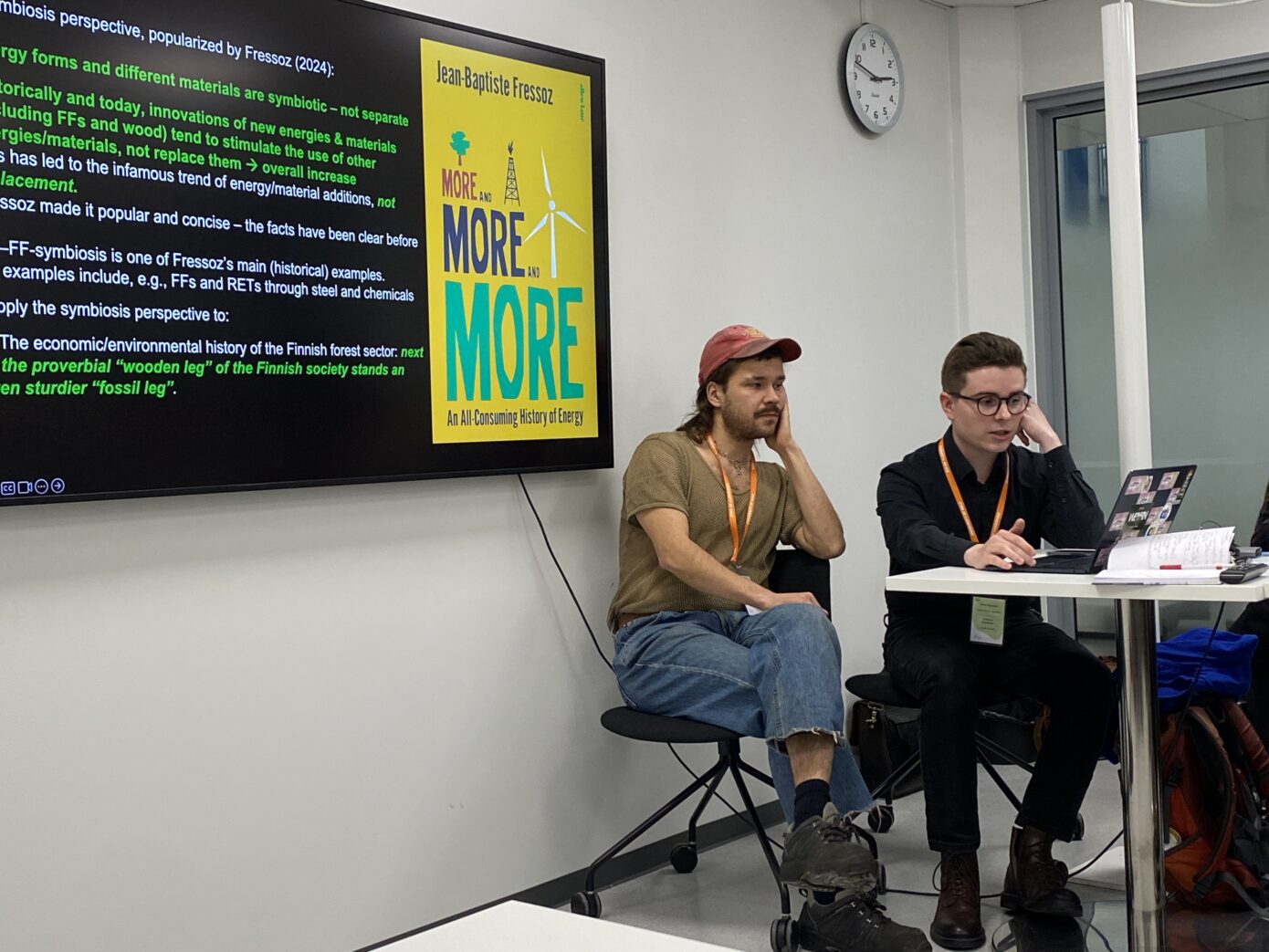
Otto Snellman ja Sakari Säynäjoki YHYS-kollokviossa 25.11.2025. Kuva: Delphine Rumo
We argue that although the fossil industry’s accusations of hypocrisy are unfounded, the “kernels of truth” about fossil dependence that they instrumentalise should not simply be thrown out with the bathwater. A shorter version of our argument can be found in this blog post.
The joint article has also generated spin-offs. Sakari and I are currently working on a peer-reviewed review article on the entanglement of Finland’s forest industry with fossil fuels and materials. At the Have We Already Given Up? discussion event, we will also present our thinking on far-right “climate realism”, a rhetorical device that has recently gained greater visibility as a means of obstructing climate action.
Tips
I strongly encourage all Nessling Foundation grantees to make full use of the foundation’s excellent support services. I have participated in the foundation’s trainings and events, organised public discussions at Puistokatu 4, and consistently received help with communications, event production, and research project administration.
If your life situation, schedule, and budget allow it, I can recommend working on a part-time basis (for example, at 80 %). While part-time work means less income per month, the grant period lasts longer, and you ease academia’s structural incentives for overwork, at least for yourself. Part-time arrangements can be agreed upon with the foundation’s grants and administration specialist.
